NEWBroken Link Checker, on Pro and Elite: we check your short links and QR codes every day and flag any that break.See how it works →Broken Link Checker is here →
Home › Use Cases › Councils & Government

Link Shortener for Councils & the Public Sector

Residents will type a short link from a letter or scan a code on a lamppost, but only if it is short, branded and obviously yours. Long portal URLs and anonymous shorteners are where engagement goes to die.

Written by the LinkShortener.io team · Reviewed by Shaun Reynolds, Founder · Last reviewed September 2026

Quick answer

LinkShortener.io gives councils and public bodies short links on their own domain, such as go.yourcouncil.gov.uk, from $13 a month on Basic: short enough to type from a letter and obviously theirs, unlike anonymous shorteners residents are told not to click. Every click and scan is counted with no cap, so a government campaign can be judged on real engagement.

That plan covers one custom domain and 350 new links or QR codes a month. Pro, at $34, is the better fit for council print, since officers can re-point a link on a leaflet, choose endings like /bins and log in as a team. Elite, at $260, allows 5,000 a month, for when every ward or library needs its own link. Pro and Elite each include bulk CSV import: an officer uploads a CSV from the dashboard, using the template provided, and each row gets its own short link and click report.

What makes a government campaign link one residents will open?

An address they can recognise as the council’s, and one short enough to type from paper. A URL shortener for government campaigns should give you both, and count every click and scan so the campaign can be judged afterwards.

Public-sector communication is full of links that have to be typed from paper: consultations in a newsletter, bin-collection changes on a leaflet, a planning notice on a lamppost, a clinic booking page in a letter. Portal URLs are long, and residents have been warned again and again not to tap short links they don’t recognise.

That warning covers every shared short domain, and ours is one of them: links made on a free LinkShortener.io account go out on tli.sh, an address any account holder can use. A subdomain such as go.yourcouncil.gov.uk can only carry the council’s own links, which is why it belongs on anything posted to households. Put a QR code beside it in waiting rooms and on notices, and nobody has to type anything. The artwork leaves the account as a PNG for screens or an SVG for the print pack, on every plan including the free one, and it is the SVG that holds its shape when a designer takes it from a letter up to an A1 planning notice. A code made on a free account carries a small created-by line beneath it; paid accounts do not, so anything downloaded before the council upgraded is worth downloading again.

Whichever domain a link sits on, it is screened for malware and phishing when it is made and a second time roughly two hours on. Anyone handed a tli.sh link they don’t trust can report a suspicious tli.sh link to us. On weekdays, each report is put in front of a member of staff, and the investigation starts there and then. For supplier forms: LinkShortener.io is run by Email Marketing Tools Limited, 153 Mortimer Street, Herne Bay, Kent, CT6 5HA (Companies House number 13556506).

Do we have to host our own shortener to get a gov.uk short address?

No. Some public bodies build their own shortener to get an official short address, which leaves their digital team owning the hosting, the security updates and the certificate renewals for as long as the links are in print. On LinkShortener.io the council keeps the address and hands over only the redirecting: your IT team adds one CNAME record for a subdomain such as go.yourcouncil.gov.uk, nothing is transferred to us, and HTTPS is switched on automatically once the domain is added. The walk-through for adding a council subdomain shows where the record goes.

Basic includes one custom domain, Pro three and Elite ten, enough for a council that also runs links for a health partnership or an arms-length company. Build one condition into the budget: those links need a paid plan behind them. Cancel, or move back to Free, and every go.yourcouncil.gov.uk link and QR code stops working, however many leaflets are still pinned to fridges.

Where this pays off is a communications team whose addresses go out on paper to households: a consultation, a bin-collection change, a clinic booking page in a letter, each one typed or scanned and then accounted for afterwards. Two limits are worth knowing before the budget line is written. Counting stops at the click or the scan, so an evaluation that has to report completed forms takes that from the council’s own analytics, through the UTM tags the link carries. And a link that never leaves the intranet does not need a council subdomain at all, since a free account gives 20 links or QR codes a month and counts every click on them.

Will the click figures stand up in a committee report?

A LinkShortener.io click report is built to be checked, which matters once campaign numbers reach committee papers and Freedom of Information answers. No plan caps the clicks and scans that are counted, so a letter to every household is measured in full. Known bots and crawlers are filtered out, though no filter can promise to catch every automated visit, and click history stays for as long as the account is open, on free and paid plans alike, so a figure quoted to councillors can still be checked next year.

Even the free click and scan report for each link gives an evaluation plenty to work with: clicks this week and in total, a count for each country, desktop against mobile, and the hours (UTC) and days when residents clicked most. Those two show whether a bin-day reminder is read over breakfast or after tea (add an hour during British Summer Time).

A scanned code or a typed address carries no clue to the piece of paper it came from. So give the letter, the leaflet and the bus-shelter poster a short link each, and the three counts show which one did the work.
What happens to car-park signs when the payment page moves?

Nothing needs reprinting, as long as the signs carry short links. Take a district council with 12 car parks. Each tariff board gets its own short link and QR code, such as go.yourcouncil.gov.uk/park-station, so the report shows scans car park by car park. The council is on Pro, at $34 a month, because it needs the chosen endings, the device rules and the editing described here, and 12 links barely touch Pro’s 2,000 a month.

Each link gets one rule that redirects by device: a scan from a phone or tablet opens the parking app’s download page, where buttons for both app stores let each driver fetch the right version. Device rules tell mobile from desktop rather than one make of phone from another, so that single rule covers every phone and tablet. The main destination is the council’s pay-online page, so anyone no rule matches, such as a resident typing the address into a laptop at home, still finds a way to pay.

When the council’s website is rebuilt and the pay-online page moves to a new address, nobody goes out with a ladder and new boards. An officer edits each car park’s short link, pastes the new address into its Destination field, and the 12 codes stay exactly as printed.

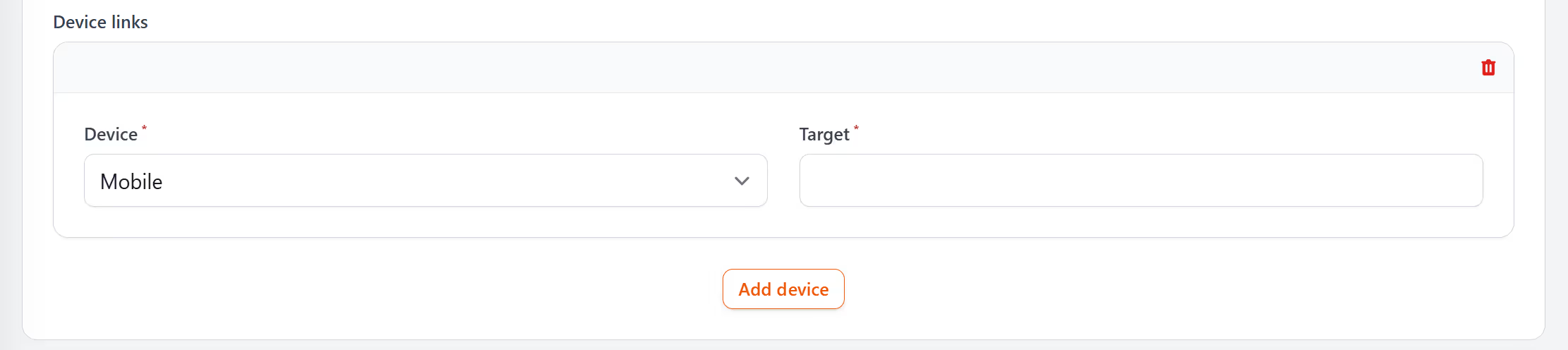
LinkShortener.io Device links form with Mobile picked in the Device menu, an empty Target box and an Add device button
The Device links form on a short link: pick a device, give it a target page, then press Add device for the next rule. For the car parks, one rule with Mobile picked is enough: phones and tablets get the app download page, and computers go to the pay-online page set as the main destination. Device rules come with Pro and Elite.
For officers and budget holders

From consultation to polling day

Can we close a consultation link automatically?

Yes, on Basic and above. Give the link an expiry date at the consultation’s closing time and make its fallback a page saying the consultation has closed and when the outcome will be published. On Pro or Elite an officer can also re-point the link by hand on the closing day. A notice still cable-tied to a lamppost in December then can’t send anyone to a survey that closed in November.

What can we do with a campaign link during the pre-election period?

On Pro and Elite an officer can re-point it: a leaflet link already through letterboxes then leads to a neutral service page while council publicity is restricted, as set out in the government’s Code of Recommended Practice on Local Authority Publicity. The printed address doesn’t change, and after polling day the link can be pointed back.

Can different departments manage their own links?

Yes. The Teams feature on Pro, Elite and Enterprise lets you invite each officer by email to sign in to the council’s account with their own login. Give each department a campaign folder, available on every plan, and its links stay together.

Do you offer plans for larger organisations?

Yes. Above Elite, the enterprise plan for large public bodies is priced to fit and covers unlimited volume and custom domains, single sign-on (SSO), white-label options, priority support and dedicated onboarding. Book a demo from that page to talk through your volumes.

Can the reports show which ward a scan came from?

Don’t rely on location data for that, because working out where a click came from by its internet connection can’t place a phone in a particular ward. Print a separate short link on each ward’s leaflet instead, such as /bins-north and /bins-south, and compare their counts. Chosen endings like those need Pro or Elite; on Free or Basic, random endings count just as well.

Where is the click data held, and what can officers see in it?

In London, UK, where LinkShortener.io hosts the app, the redirect servers and the databases. If a Freedom of Information request asks for a campaign’s figures, the report or CSV download an officer sends back holds totals only, with no resident’s IP address or browser details in either. The supplier, Email Marketing Tools Limited, has ICO registration number ZB421759.

Will residents see an advert before the council’s page opens?

No. LinkShortener.io doesn’t place adverts on short links, free ones included, so a resident who scans the code on a bin-day leaflet goes straight to the council’s page rather than a sponsor’s. That matters for public information, where an advert in front of a council page could be read as an endorsement.

Can a depot noticeboard link to a staff-only page?

Yes, as long as the page itself sits behind the intranet’s own login, because short links can’t carry a password. Staff who scan the QR code on the board reach the gritting rota or a new safety procedure after signing in, while anyone who photographs the notice gets no further than the sign-in screen.

Can we pay annually instead of monthly?

Yes. Paying for a year up front costs ten months’ worth: Basic comes to $130, Pro to $340 and Elite to $2,600. One annual payment is also simpler to match to a single financial year’s budget than twelve monthly charges.

Sign up today for free!

Pilot one consultation on a free account, which covers 20 links or QR codes a month with no card taken, then move up to a paid plan and the council’s own subdomain before a link goes out to every household.