NEWBroken Link Checker, on Pro and Elite: we check your short links and QR codes every day and flag any that break.See how it works →Broken Link Checker is here →
Home › Use Cases › E-commerce

Link Shortener for E-commerce & Online Stores

Product URLs are long, ugly and full of tracking parameters. A short link on your own domain fits a Story sticker, a text or a packing insert, and gives each channel its own click count.

Written by the LinkShortener.io team · Reviewed by Shaun Reynolds, Founder · Last reviewed September 2026

Quick answer

LinkShortener.io is a link shortener for e-commerce product links: it turns a long product URL, variant ID and UTM tags included, into a short link or QR code, with every click and scan counted whichever plan you are on, Free included. The free allowance is 20 links or QR codes a month combined; your own short domain needs Basic ($13 a month), and re-pointing a sold-out product’s link needs Pro ($34).

What makes a link shortener good for tracking product links?

A link shortener built for product tracking gives each channel a link and a count of its own, and it leaves your tracking tags alone. On LinkShortener.io you make one short link per product per channel (a Story sticker, the SMS, each creator), and every link keeps a separate tally. Even on Free, the report breaks those clicks into this week and all time, by country, desktop against mobile, and by the hours (UTC) and days people click most.

A product URL carrying a variant ID, a collection path and three UTM parameters is unusable anywhere a person has to read or type it, which is why the short link goes out instead. Nothing ages out of the report while your account stays open, free or paid, so this November’s Black Friday link can be read against last year’s.

Clicks are not sales, though. The order is placed in your store, so keep UTM tags on each destination (the free UTM builder writes them) and let your store’s own analytics match orders to the channel. Google’s help page on campaign URLs says a tagged link should always carry utm_source, utm_medium and utm_campaign, and Google Analytics shows their values in its Traffic acquisition report.

Where does a store need a short product link?

  • Social bios and Stories: a link-in-bio page for the profile (Basic and up) and a separate short link for each Story sticker or DM. Most Instagram captions can’t be tapped, and the Instagram link shortener page lists the places that can.
  • SMS and WhatsApp campaigns: characters are money in a text, so short links for SMS keep messages tight and trackable.
  • Influencers and affiliates: one short link per partner means each has its own click count you can report back to them. See our guide to short links for affiliate marketing.
  • Packaging inserts: QR codes to reorder pages, care guides, review requests and loyalty sign-ups.
  • Email campaigns: clean branded links instead of raw tracking URLs, plus integrations with Mailchimp, GetResponse and ActiveCampaign, all three open to Free accounts. Mailchimp is set up inside your LinkShortener.io account and keeps your sent campaigns in sync. GetResponse and ActiveCampaign are copy and paste: grab the short link for each product and drop it into the restock email or launch text before you send it.
  • Seasonal campaigns: on Pro or Elite, re-point the sale link to the next offer when this one ends.

More products than bio links: which ones get a spot?

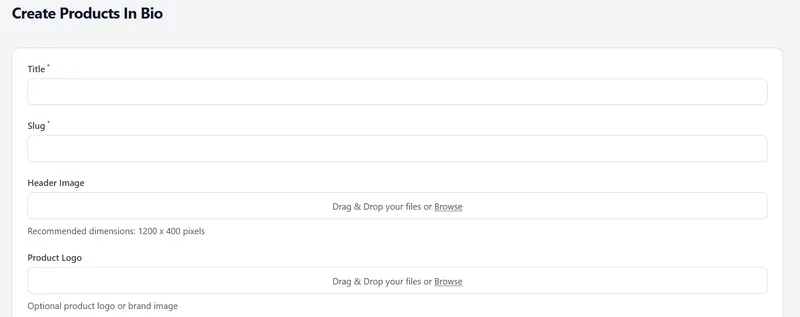
None has to miss out. A product in bio page puts several products behind a single link in your profile: each block has a photo, name, price and a button to the product page, and checkout still happens in your own shop. Swap the blocks as stock changes and that bio link stays put. Building one takes Basic ($13 a month) or a bigger plan.
LinkShortener.io Create Products In Bio form with title, slug, header image and product logo fields
Setting up a shop page in the app: a title, the slug that becomes its link, a header image (1200 × 400 recommended) and an optional store logo. Needs Basic or above.

Which plan does an online shop need?

The plan an online shop needs depends on three jobs: one starts on Basic, the other two on Pro. Custom branded domains begin on Basic ($13 a month), which includes one. Editable destinations, for swapping a sold-out product for its replacement without touching the post, begin on Pro ($34 a month), which also brings three domains.

The third job, bulk CSV import for a whole catalogue, comes with Pro and Elite ($260 a month). There is no upload screen: a short form in the dashboard takes the number of products, where their links sit today and the domain to put them on, and our team takes it from there. Pro and Elite also add geo-targeting, which sends each country to its own store, and redirect by device, which lets phone and tablet shoppers open a different page from those browsing at a laptop or desktop.

Which shops get the most from this: those selling one product through several channels at the same time, where the post stays up long after the stock behind it has gone. A shop that prints nothing, posts one link that never moves and sends every other shopper through its own site navigation has less to gain, and a launch of four or five links never runs into the 20 a month a free account allows. The sums change when a sell-out would otherwise mean editing posts, texts and artwork already out in the world, which is what the Pro plan above covers.

One new scent, four links and a sell-out

Take a candle shop on Pro launching a scent called Ember on its own short domain, go.yourbrand.com. On launch day it makes four: go.yourbrand.com/ember-story for a Story sticker the shop pins to its Instagram Highlights, /ember-sms for the text to subscribers, /ember-video under a creator’s video, and a QR code on the packing insert that opens the refill page.

Each destination carries its own UTM tags. The SMS one, https://yourbrand.com/products/ember-soy-candle?variant=4012&utm_source=subscribers&utm_medium=sms&utm_campaign=ember-launch, runs to 124 characters; go.yourbrand.com/ember-sms is 26, which leaves most of a 160-character text for the message. Custom endings like /ember-sms are a Pro feature.

Ember sells out on day three. The shop re-points the three product links to the restock page, and the pinned Story, the text and the video stay exactly as they were. The launch used 4 of the 2,000 links or QR codes Pro allows each month.

Read next if you sell online

Want to know what a count per link can tell you once a campaign is running? How to track clicks on short links walks through it. Printing an insert like Ember’s? Short links and QR codes for packaging covers what to check on a pack code before the print run, and the use cases page lists every other audience.

Shop owners ask

Product link questions

What should an e-commerce store look for in a URL shortener?

A count of its own for every product link, with no cap on clicks or scans; variant IDs and UTM tags that reach the product page untouched; no advert or preview page before the product opens; your own short domain; and a way to re-point a link after it is posted or printed. A free LinkShortener.io account covers the first three; your own domain starts on Basic at $13 a month and re-pointing on Pro at $34. LinkShortener.io does not track conversions, so sales are matched to channels through UTM tags in your store’s own analytics.

Which URL shorteners let an online shop track product links for free?

LinkShortener.io does: its Free plan counts each click and scan on up to 20 product links or QR codes a month, with totals by country, desktop or mobile, and busiest hour and day. On 10 September 2026, the Bitly pricing page gave its free tier 5 short links a month, and the TinyURL page showed tracked clicks starting on its $9 a month Pro plan. Orders sit outside that count: LinkShortener.io has no conversion tracking.

Can I shorten a product link that has UTM parameters?

Yes. Paste the full URL with its UTM tags as the destination; the tags come through the redirect untouched and arrive on your product page, so your store’s analytics credits the visit to the right source. The free UTM builder helps you keep the tags consistent.

Will a short link open the right colour or size?

Yes, as long as the long URL does. Copy the product URL with the option already picked (on Shopify that ends in something like ?variant=4012) and shorten that; the query string passes through the redirect, so the page opens with that colour or size selected. Make a link per variant if you want to see which one gets tapped.

Will a Shopify discount code still apply through a short link?

Yes. A Shopify shareable discount link such as yourbrand.com/discount/EMBER10?redirect=/products/ember-soy-candle can sit behind a short link: the shopper lands on the product with the discount waiting at checkout, and the short link counts the click. Each order records the code used, so giving every channel its own code and discount link shows which one turned into sales.

Can I see which influencer sent the most traffic?

Yes. Give each creator or affiliate their own short link and set the totals side by side. Our counts skip visits from known bots and crawlers, which matters when a creator’s fee depends on the numbers.

Why does my store’s analytics show fewer visits than my short links?

Because they count different things. Our redirect logs the click before the product page loads; your store’s analytics logs a session only once that page loads and its tracking script runs, so shoppers who back out early or block tracking never appear there. Expect the short-link count to be the higher figure, and compare trends between channels rather than the totals.

Does the QR code on my packaging need to be updated when pages change?

Not on Pro or Elite. The code on the pack leads to a short link, so you change where that link goes and the printed code keeps working. On Free and Basic a destination can’t be changed, so a new page means a new link and a new code at the next print run. Check the domain before printing as well: a pack code built on go.yourbrand.com stops redirecting once the subscription ends or the account goes back to Free, while one made on tli.sh keeps redirecting.

Which plan lets me change where a short link points after I have shared it?

Pro and Elite. Editing a link destination after it has been shared is available on Pro at $34 a month and Elite at $260 a month, not on Free or Basic. Pro covers 2,000 links or QR codes a month, 3 custom domains and custom slugs, so a sold-out product is re-pointed everywhere the old link already lives. Annual billing makes Pro $340 a year.

Can I create short links for my whole product catalogue at once?

Yes, on Pro or Elite. Open Bulk CSV import inside your LinkShortener.io account , download the template, list one product page per row and upload it (up to 200 rows a file), and every product row becomes a separate short link that reports its own clicks. Each imported link comes out of the monthly allowance (2,000 for Pro subscribers paying $34, 5,000 for Elite at $260 with 10 custom domains), and nothing is billed beyond it. Annual billing makes Elite $2,600 a year, which is two months free.

Does the free plan give me 20 short links and 20 QR codes a month?

No. Free is 20 short links or QR codes a month combined, so 12 product links leaves 8 QR codes for packaging. The counting has no cap: every click on those links and every scan of those codes is recorded. A free account is required and no card is needed. Basic at $13 a month raises the allowance to 350 a month.

What happens if a product launch uses up the month’s allowance?

Nothing extra is billed, on any plan. New product links and QR codes wait for next month’s allowance, or for you to move up a plan if you decide to, while every link already posted, texted or printed keeps redirecting, and clicks on them are never charged.

Do I need to install an app on Shopify or WooCommerce to use short links?

No. A short link points at whatever product URL your store already produces, so there is nothing to install on your theme and no code to add. Shopify, WooCommerce and any other platform work the same way. The only thing to set up is a free LinkShortener.io account.

Can one short link send shoppers in different countries to different stores?

Yes, from Pro upwards: $34 a month for Pro, $260 for Elite. A country rule can send shoppers in Ireland to your euro store, and a device rule separates phones (tablets included) from computers, so mobile shoppers can land on the download page for your shop app, or a product page built for small screens, while desktop buyers get the full storefront. When a click matches both, the country rule wins, so one link in a bio or a text still covers every market. Anyone who matches no rule goes to the link’s main destination, so point that at the store most of your shoppers use. Free and Basic have no redirect rules, but their report still lists the countries the clicks came from.

Sign up today for free!

Run your next product launch from a free account, and upgrade to Basic when the packaging needs your own domain and a logo in the QR code.