Quick answer
Yes, you can shorten affiliate links: the redirect keeps the tracking parameters that earn your commission and hides the long, ad-like URL. A short link works where a raw network URL cannot (a bio, a podcast, print), and a free LinkShortener.io account makes 20 a month, shared with QR codes. You must still disclose the affiliate relationship.
Paste a tagged affiliate URL into LinkShortener.io as the destination and its query string survives the redirect unchanged, so the tag, tracking ID and any sub-ID reach the retailer as the network issued them (as do UTM tags from our free UTM builder). Every click is tallied on any plan, however many arrive. Free use means signing up (no card asked for) and making up to 20 new links a month, with any QR codes drawn from the same 20; sending an existing link to a new offer is a job for Pro, at $34 a month, or Elite.
A raw affiliate URL is built for the network, not for the person clicking it. The parameters hanging off the end (a tag, a tracking ID, sometimes a sub-ID and a campaign marker) exist so that when a sale happens, the commission lands with you. That machinery is the point, and it is also what makes the link long, ugly and fragile. Shortening is how you keep the machinery and lose the mess, though it comes with obligations that do not disappear just because the URL got tidier.
What's wrong with a raw affiliate URL?
Three problems, in rising order of cost.
They look like what they are. Readers recognise a parameter-stuffed URL as an ad, and that recognition changes behaviour: a link that reads as tracking machinery invites more hesitation than one that reads as a recommendation.
They are unusable outside the browser. A raw network URL cannot be read aloud on a podcast, does not fit a social bio, and looks absurd in print. Entire channels are closed to it.
They break in transit, and they break silently. Long URLs wrap and split in plain-text emails and forums; messaging apps and older CMSs sometimes mangle long query strings; a copy-paste that grabs the URL but not the final parameters produces a link that still works, minus the part that credits you. A broken page gets reported; a stripped tag never is.
What a branded short link fixes
go.yourbrand.co/standing-desk reads like a recommendation instead of a tracking string. It is speakable, printable, and fits anywhere. Because a short link is a redirect, the full tagged URL sits safely behind it: the shortener forwards visitors to the exact destination you saved, parameters intact, with nothing left exposed for an app or a line-wrap to chew on.
Running the links on your own domain (set up once with custom branded domains) adds the trust layer: every link carries your name rather than a generic shortener's, so the association built click after click is with you. And keeping every affiliate link in one dashboard gives you a single place to update any of them. Offers expire, and we will come back to that.
One honest note first: shortening improves how a link reads. It does not change what the link is.
Shortening never removes the duty to disclose
An affiliate link is a paid relationship, and advertising rules in most markets require that relationship to be made clear. In the UK, the CMA and ASA expect commercial relationships to be obvious to the people seeing the content; in the US, the FTC requires clear and conspicuous disclosure of material connections.
The duty attaches to the relationship, not the URL. A short link discloses nothing on your behalf, and hiding the network's domain arguably raises the bar, because the reader now has no visual clue at all. The disclosure has to do the work: plain words like "affiliate link" or "I earn commission", placed near the link and before the click, not buried in a footer. This is not legal advice, so check the rules that apply to you and your market.
There is a second rulebook: the programme's own terms. Some programmes restrict "cloaking", which means shortening or redirecting in ways that obscure where a link leads or which network it belongs to. Amazon Associates sets out its conditions in writing (see the Amazon question below), and other networks take their own positions. None of this makes shortening off-limits; it makes reading your programme's terms a step you take before shortening, not after a warning email arrives.
Each live LinkShortener.io link answers with one 302 redirect to the address you saved, with no advert, preview page or frame in between. We never slip our own affiliate codes, extra tracking or a third-party redirect into a customer's link, so no one else's commission code can come between your reader and the retailer.
Where do short affiliate links help most?
Wherever a long URL can't be tapped, read out or printed cleanly, as long as your programme allows that channel.
- Social bios. One link slot, no room for a query string. A branded short link pointing at your current offer (or a page listing several) is the standard play.
- YouTube descriptions. A tidy list of
go.yourbrand.co/camera,/tripod,/micreads like a kit list. The same list as raw network URLs reads like a wall of static. The video links you post alongside them can be shortened and counted too, as our YouTube URL shortener guide shows. - Podcasts and anything spoken. "Go to yourbrand dot co slash deal" is the only way an affiliate link survives audio, because a raw network URL cannot be read aloud at all.
- Print and QR. Flyers, inserts, event screens. A dynamic QR code encodes a short link, so every scan is recorded like a click. And on LinkShortener.io's Pro and Elite plans, the printed code can be repointed later without reprinting.
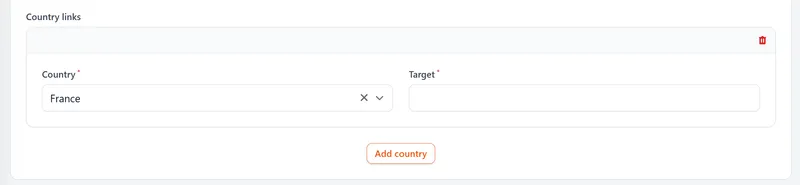
- Readers in more than one country. Some retailers run a separate programme and tag for each country's store. On Pro and Elite, country rules send UK visitors to the UK store's tagged URL and US visitors to the US one; everyone else gets the link's main destination.
Check the channel first. Amazon.co.uk's Associates Program Policies (read 16 September 2026) bar its affiliate links from printed material, ebooks, physical mailings and oral solicitation, though they are allowed in emails, texts and social direct messages that people opted in to receive. Other networks set their own limits, so confirm that your programme allows spoken and printed links before using the podcast and flyer ideas above.
Your clicks versus the network's numbers
Once you shorten, you have two sets of figures: your short-link clicks and the network's own reporting. They will not match, and they are not supposed to.
Short-link clicks are the top of the funnel: every visit that reached the redirect. LinkShortener.io keeps known bots and crawlers out of those figures, though a scanner that disguises itself can still slip through, and a reader who taps twice counts twice. The network's click count is measured further downstream with its own filters, and its conversion figures depend on its tracking surviving consent banners, blockers and cross-device behaviour.
Use each for what it is good at. Short-link clicks, measured the same way everywhere, are ideal for comparing placements: which video description, which bio, which episode actually sends people. The network's report is the source of truth for money. And the gap between them is diagnostic: plenty of short-link clicks against a network report of almost nothing means something in between is broken (usually a dead or mistagged destination), and your dashboard caught it before your payout did.
Even the free link tracker helps here: it breaks each link's clicks down per country and per device type (desktop or mobile), next to this week's count, the running total and which UTC hours and which days bring in the most clicks, so a podcast plug tends to show up as a spike in release week while a video description keeps ticking over. From Pro, a link on your own domain can also fire your Meta, Google, LinkedIn or TikTok pixel on the way through, so you can retarget the people who clicked.
What happens to old affiliate links when an offer ends?
They go on resolving to the dead offer: a raw affiliate URL for good, a short link only until its destination is repointed. Affiliate offers die constantly. Products go out of stock, promotions expire, programmes close, networks change their deep-link formats. A raw URL pasted into a three-year-old YouTube description keeps sending viewers to a 404 forever, earning nothing.
An editable short link turns that permanent loss into a one-line fix: repoint the destination to the replacement product or current offer, and every placement you have ever made (bios, descriptions, pinned posts, printed cards) follows. The new destination still needs to carry your tag and meet your programme's terms; editing where a link points does not edit your obligations.
The domain decides how long a link lasts. Links on LinkShortener.io's shared tli.sh domain have no end date: they carry on redirecting after a paid plan ends or you step down to Free, and the clicks they have collected can still be read in your reports while the account stays open.
Your branded domain works differently. Cancel, or downgrade to Free, and links on it no longer resolve, because custom domains are a paid feature (the $13-a-month Basic plan has one). If that domain sits in years of video descriptions, keeping the plan is part of what those links cost.
Commissions never appear in our reports: clicks and scans are all they count, so an affiliate who wants earnings and traffic in one place has to read the network dashboard alongside ours. Shortening answers a different problem, the offer that will not last. A link already sitting in a bio and in video descriptions written months apart can be pointed somewhere new in a single edit, which comes with Pro at $34 a month.
FAQ
How do I shorten an affiliate link?
Copy the complete affiliate URL from your network or programme dashboard, with the tag and tracking ID still on it, and use it as the destination when you create a short link in LinkShortener.io. On a free account the link sits on tli.sh; Basic ($13 a month) lets it sit on your own domain, and Pro ($34 a month) lets you choose a named ending, /standing-desk for example, at the moment you create it. Before sharing, click the finished link once and check that the retailer's page opens with your tag still in the address.
Does Amazon allow shortened affiliate links? Treat this as a question for Amazon's current terms, not for a blog post. Amazon.co.uk's Associates Program Policies (read 16 September 2026) forbid using a link shortening service in a way that makes it unclear you are linking to Amazon, and disqualify sales that come through a 'Redirecting Link', one that passes shoppers through an intermediate site without them clicking anything there. Amazon's own SiteStripe toolbar (Get Link, Text) builds an amzn.to short link with your Associate ID and tracking ID already in it, so many affiliates keep Amazon products on those links and use their own branded short links only where the terms clearly permit them. Read the current Associates terms before shortening. The account at risk is your own.
Do short links break affiliate tracking? No. The redirect forwards visitors to the full tagged URL you saved, parameters intact, and the network's tracking then works exactly as on a raw link. Two cautions: always shorten the final tagged URL rather than the bare product page, and avoid stacking one shortener on another. Redirect chains are where some programmes draw a line, so check yours.
Do I still have to disclose an affiliate link if it is shortened? Yes, always. Disclosure rules attach to the commercial relationship, not the format of the URL. UK and US advertising regulators both expect the relationship to be clear regardless of how the link looks. If anything, disclose more prominently, since the URL no longer gives the reader any clue. Check the rules that apply to you.
Why don't my short-link clicks match my affiliate dashboard? Because they measure different points in the journey. Your short-link report counts arrivals at the redirect; the network counts what its own tracking accepted, under its own filters, then attributes conversions on top. Expect a gap. Worry only when the gap is enormous, which usually means a dead destination or a stripped tag.
Can I change where an affiliate short link points after sharing it? Yes, if your link shortener supports editable destinations. That is the feature that rescues expired offers: repoint the link once and every past placement follows. Keep the new destination compliant (it should carry your affiliate tag and stay within the programme's rules) and the swap is invisible to your audience. LinkShortener.io offers this on Pro ($34 a month) and Elite. There is no cap on how often a link is repointed, and none of those changes counts against the monthly allowance.